
Maeng Da vs Bali: I've Used Both for 10 Years — Here's the Difference
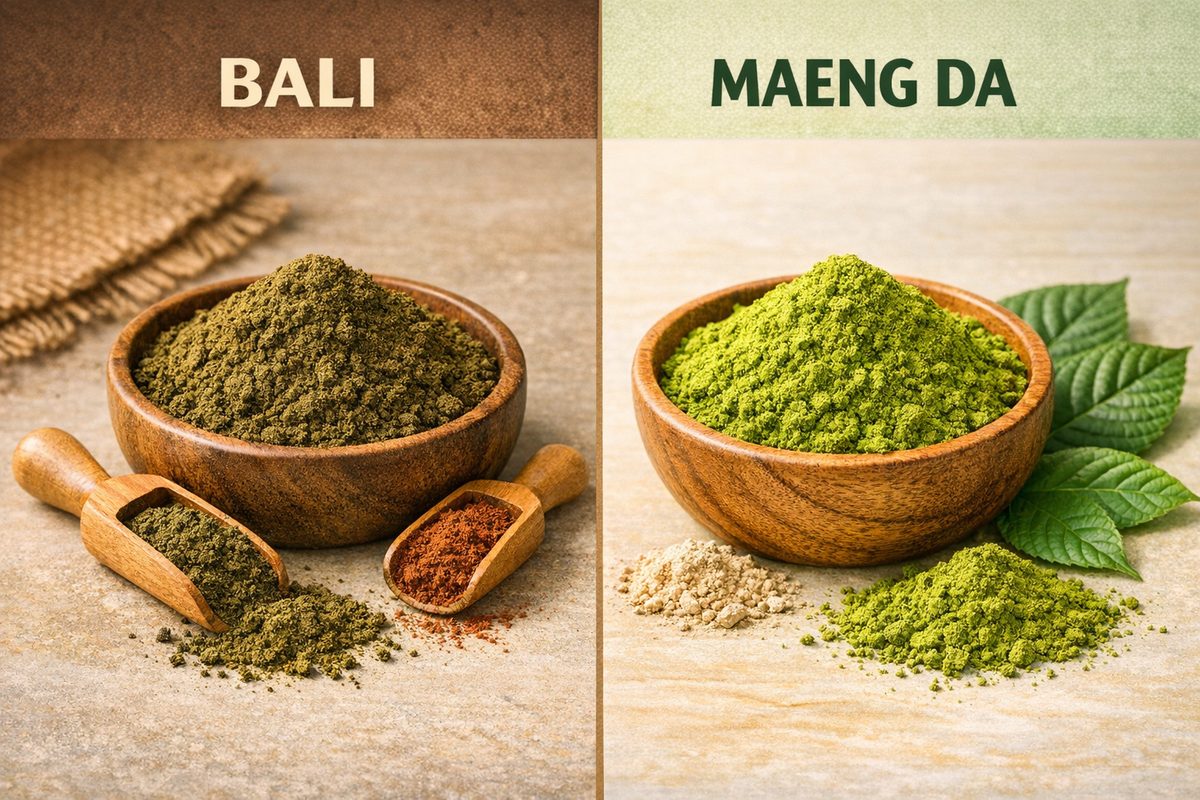
If you're trying to figure out whether Maeng Da or Bali is the right strain for you, you're asking the right question. These two are the most popular kratom strains on the planet, and for good reason—they're both excellent. But they're not the same, and choosing wrong means a disappointing first experience.
I've been using both strains regularly since 2016. Maeng Da was my first ever kratom purchase, and Bali came about three months later. Ten years in, they're still the two strains I always have in my rotation. Here's everything I know about how they actually differ when you put them side by side.
Table of Contents
Quick Comparison: Maeng Da vs Bali at a Glance
| Category | Maeng Da | Bali |
|---|---|---|
| Primary Effects | Energy, focus, mood lift, strong relief | Relaxation, calm, moderate relief, warmth |
| Potency | High (8/10) | Moderate (6/10) |
| Duration | 4–6 hours | 3–5 hours |
| Best For | Experienced users, energy, focus | Beginners, relaxation, evening use |
| Price (avg/oz) | $8–$14 | $7–$12 |
| Beginner-Friendly? | Moderate — start low | Yes — very forgiving |
What Is Maeng Da Kratom?
Maeng Da translates loosely from Thai as "pimp grade," which sounds ridiculous but tells you everything about its reputation—this is the top shelf stuff. It was originally developed through selective grafting of kratom trees in Thailand to produce leaves with a higher alkaloid concentration. The result is a strain that hits harder, lasts longer, and has more pronounced effects than just about anything else on the market.
What makes Maeng Da interesting is that it comes in all three vein colors—red, green, and white—and each one feels distinctly different. White Maeng Da is the energy monster. Green Maeng Da is the balanced all-rounder. Red Maeng Da is the powerhouse for discomfort and relaxation. No matter which vein you pick, you're getting a strain that was bred for potency.
I started with Red Maeng Da back in 2016 and was legitimately surprised at how strong it was compared to the random kratom I'd tried before. It was the strain that made me understand why people were so passionate about this plant. Ten years later, some form of Maeng Da is in my rotation every single week.
The alkaloid profile is where Maeng Da really separates itself. It consistently tests higher in mitragynine—usually 1.2% to 1.5% by weight—compared to most other strains that land between 0.8% and 1.1%. That difference might look small on paper but you absolutely feel it in practice. Gram for gram, Maeng Da just hits different.
What Is Bali Kratom?
Bali kratom is the classic. It's probably the strain most people try first, and there's a reason for that—it's mild, well-rounded, and incredibly forgiving. Despite the name, most "Bali" kratom actually comes from Borneo these days. The name stuck because Bali was historically the port where Indonesian kratom was shipped from.
Where Maeng Da was engineered for potency, Bali just does its thing naturally. The alkaloid profile is gentler, the onset is smoother, and the overall experience feels less intense. That's not a criticism—it's exactly what makes Bali so popular. Not everyone wants to get knocked over. Sometimes you want a warm, calm wave that takes the edge off without putting you on the couch.
Bali is most commonly found in the red vein variety, and that's what most people mean when they just say "Bali." Red Bali is the quintessential relaxation strain. It's warm, it's soothing, and it has just enough mood lift to keep things pleasant. Green Bali exists too and adds a bit more energy to the mix, but red Bali is the classic for a reason.
I added Bali to my rotation about three months after I started with Maeng Da, and it immediately earned its place. There are days when Maeng Da is too much—when I don't need the intensity, when I just want to unwind. That's where Bali shines. It's the comfortable pair of shoes in your kratom closet.
Head-to-Head Comparison
Energy
Maeng Da wins this one and it's not close. White and Green Maeng Da are legitimate energy strains that can replace your morning coffee. Bali, especially Red Bali, is the opposite—it's more likely to make you want to sit on the couch than run a marathon. If energy is what you're after, Maeng Da is your strain. At lower doses (2-3g), Green Maeng Da gives me a clean, focused energy that lasts 4-5 hours without any caffeine jitters.
Relaxation
Bali takes this category. Red Bali is one of the most relaxing strains I've ever used. It has this warm, heavy quality that melts tension out of your body. Maeng Da can be relaxing too—Red Maeng Da at higher doses is great for unwinding—but even then, there's an underlying alertness that Bali doesn't have. When I want to genuinely switch off for the evening, Bali is what I reach for.
Mood
This one's close, but I'll give a slight edge to Maeng Da. Both strains are great for mood, but Maeng Da has a more euphoric quality—especially Green Maeng Da. It's that "everything is right with the world" feeling that makes you want to tackle your to-do list. Bali's mood lift is mellower, more of a contentment than a surge. Both are great, just different flavors.
Duration
Maeng Da lasts longer in my experience. I consistently get 4-6 hours from a dose of Maeng Da versus 3-5 from Bali. This makes sense given the higher alkaloid concentration—there's simply more active material for your body to process. Maeng Da also has a slower taper-off, where Bali can drop off a little more abruptly toward the end.
Potency
Maeng Da is meaningfully more potent at the same dose. If you take 4 grams of each, Maeng Da will feel like 20-30% more than Bali. This is a double-edged sword—more potent means you need less, which saves money, but it also means beginners can overshoot more easily. With Bali, you've got a wider margin of error.
Consistency
I've found Maeng Da to be more consistent batch to batch. Because it's a premium strain that vendors know customers are picky about, quality control tends to be tighter. Bali can vary more, especially from budget vendors. That said, from a good vendor like Kraken, both are remarkably consistent.
Value
Bali is cheaper per gram, but Maeng Da is more cost-effective per dose because you need less. They essentially wash out. If you're buying on a tight budget and taking the same amount regardless, Bali saves you a few bucks. If you're optimizing for cost per effective dose, Maeng Da edges ahead.
When to Choose Maeng Da
Maeng Da is the right pick if you're an experienced user who knows their tolerance and wants stronger effects per gram. It's the strain I recommend when someone tells me they need energy and focus for work, or when they've tried milder strains and found them underwhelming.
- You've used kratom before and understand how your body reacts
- You want energy and focus—White or Green Maeng Da are top tier for this
- You want maximum potency for your money
- You need all-day effects—the longer duration means less re-dosing
- You want versatility—Red, Green, and White give you three distinct experiences from one strain family
If those sound like your priorities, grab some Red Maeng Da from Kraken or their White Maeng Da and see why this strain has been the king for over a decade.
When to Choose Bali
Bali is the right call for new users, for people who prioritize relaxation, and for anyone watching their wallet. It's a strain that's almost impossible to have a bad experience with, and that matters more than most people realize.
- You're new to kratom—Bali's forgiving nature makes it the safest first strain
- You want relaxation—Red Bali is one of the best evening strains available
- You're on a budget—Bali is consistently cheaper per gram than Maeng Da
- You want something gentle—lower potency means less risk of wobbles or nausea
- You use kratom for unwinding after a long day rather than powering through one
For a solid starting point, Kraken's Bali powder is one of the most consistent Bali products I've used. It's what I recommend to every first-timer who asks.
Can You Mix Maeng Da and Bali?
Yes, and honestly? It's one of my favorite blends. Mixing Maeng Da and Bali gives you the best of both worlds—the potency and energy of Maeng Da smoothed out by the warmth and relaxation of Bali. The result is this incredibly balanced, full-spectrum experience that neither strain gives you on its own.
My go-to blend ratio is roughly 60% Green Maeng Da and 40% Red Bali. That gives me the focus and mood lift I want from Maeng Da without any edginess, plus just enough of Bali's calming quality to keep everything smooth. On days when I need more relaxation, I'll flip it to 40/60. The beauty of mixing is that you can dial in exactly the experience you want.
A few tips if you want to try mixing:
- Start with your normal total dose—don't add the two on top of each other. If you normally take 4g, use 2.4g Maeng Da and 1.6g Bali.
- Mix the powders thoroughly before measuring. Clumps mean inconsistent effects.
- Keep notes on ratios until you find your sweet spot. It's different for everyone.
- Don't mix more than two strains at once. Three-way blends just muddy everything.
My Personal Preference: I Use Both
After ten years, I don't pick one over the other. I use both for different situations, and that's honestly the right approach for most regular users. Here's what a typical week looks like for me:
Mornings: Green Maeng Da or White Maeng Da, 3-4 grams. This is my coffee replacement. I take it on an empty stomach with a glass of water about 30 minutes before I need to be productive. By the time I sit down to work, I'm focused, alert, and in a genuinely good mood. This carries me through until early afternoon.
Evenings: Red Bali, 4-5 grams. This is my unwinding ritual. After the day is done, I take Bali and let it do its thing. Within 20 minutes, the tension from the day starts dissolving. It's not sedating at that dose—I can still hold a conversation and watch a movie—but it takes the edge off in a way that's hard to describe until you've felt it.
Weekends: My Maeng Da/Bali blend. No work pressure means I can just enjoy the full-spectrum experience. It's my favorite way to use kratom when I don't need to be either wired or relaxed—just present and content.
If someone forced me to pick only one for the rest of my life, I'd pick Maeng Da because of the versatility across vein colors. But I'd miss Bali terribly. The honest truth is that they complement each other perfectly, and most experienced users end up keeping both in rotation.
Where to Buy Maeng Da and Bali
Quality matters more with these two strains than almost any other, because bad Maeng Da and bad Bali are painfully common. Budget vendors cut corners on these since they're the highest-volume strains. You need a vendor who actually tests their product and maintains consistency batch after batch.
My top recommendation for both strains is Kraken Kratom. They're AKA-GMP certified, they lab-test every batch, and their Maeng Da and Bali have been consistently solid for years. I've been ordering from them since 2019 and I can count on one hand the number of times a batch disappointed me.
Get Maeng Da from Kraken Kratom
Lab-tested, AKA-GMP certified. The most consistent Maeng Da I've found in 10 years of buying.
Shop Red Maeng Da Shop White Maeng DaGet Bali from Kraken Kratom
Smooth, reliable, and beginner-friendly. The Bali I recommend to every new user.
Shop Bali KratomFor more vendor options, check out our best kratom vendors guide where I rank and review over a dozen vendors based on real testing.
Maeng Da vs Bali FAQ
Which is stronger, Maeng Da or Bali?
Maeng Da is stronger at the same dose. It has higher alkaloid concentrations—typically 1.2-1.5% mitragynine compared to Bali's 0.8-1.1%. In practical terms, you need about 20-30% less Maeng Da to achieve the same intensity of effects. This makes Maeng Da the better choice for experienced users who want maximum potency, but it also means beginners need to be more careful with dosing.
Is Bali or Maeng Da better for beginners?
Bali is significantly better for beginners. Its lower potency means you have a wider margin of error with dosing—if you overshoot by a gram, you'll probably be fine. With Maeng Da, that same overshoot could mean nausea and the wobbles. Bali's effects are also gentler and more predictable, which helps new users understand what kratom feels like without being overwhelmed. Start with 2-3 grams of Red Bali, see how it goes, and adjust from there.
Can I switch between Maeng Da and Bali?
You absolutely can, and I'd actually encourage it. Switching between the two—or even rotating daily—helps keep your tolerance lower than sticking with just one strain. The slightly different alkaloid profiles give your receptors some variety. My personal rotation has been Green Maeng Da for mornings and Red Bali for evenings for years now, and it keeps both strains feeling effective.
Which is cheaper, Maeng Da or Bali?
Bali is about 10-20% cheaper per gram at most vendors. However, since Maeng Da is more potent, you generally use less per dose. When you calculate cost per effective dose rather than cost per gram, the two strains come out roughly equal. If you're buying on a strict budget and dosing the same amount regardless, Bali will save you money. If you're willing to adjust your dose downward with Maeng Da, the cost-effectiveness is comparable.