Is Kratom Legal in My State? The Complete 2026 Guide
Last updated: July 21, 2026. I re-check this page against the American Kratom Association's state tracker and primary state sources whenever legislation changes. Most recent changes: the DEA moved on July 1, 2026 to temporarily schedule concentrated 7-OH (kratom leaf is not included, details), and a federal bill—the END 7-OH Act (H.R. 8000)—would schedule synthetic 7-OH by statute while exempting naturally occurring 7-OH in kratom. Kansas and Tennessee both banned kratom effective July 1, 2026; Rhode Island reversed its ban to re-legalize kratom on April 1, 2026; and on Martha's Vineyard, the Edgartown (June 9, 2026) and Tisbury (July 2026) Boards of Health banned local kratom sales.
If you're wondering whether you can legally buy and use kratom where you live, you're not alone. This is one of the most common questions I get. The short answer is that kratom is legal in most of the United States, but there are a handful of states and even some individual cities where it's either banned outright or heavily regulated.
I've been following kratom legislation closely for years, and I keep this page updated whenever laws change. Below you'll find the status of every single state, plus details on the tricky ones.
Federal update: the DEA is moving to schedule 7-OH (not kratom leaf)
As of July 21, 2026, kratom leaf and plain kratom powder remain federally legal. But on July 1, 2026 the DEA sent two Notices of Intent to the Federal Register (published July 6) to temporarily place concentrated 7-hydroxymitragynine (7-OH) into Schedule I. The order cannot take effect before August 5, 2026.
This does not ban kratom. It targets a specific concentrated alkaloid found in some enhanced extracts, tablets, gummies, and shots. Full breakdown below, or see the dated 7-OH scheduling tracker for the running status.
Quick Summary
Kratom is legal in most U.S. states as of 2026. Here's the short version:
- Fully illegal (9 states): Alabama, Arkansas, Connecticut, Indiana, Kansas, Louisiana, Tennessee, Vermont, and Wisconsin
- Recently changed: Kansas and Tennessee enacted bans effective July 1, 2026. Rhode Island reversed its 2017 ban on April 1, 2026, becoming the first state to re-legalize kratom (now regulated for ages 21+). On Martha's Vineyard, Edgartown (June 9, 2026) and Tisbury (July 2026) banned local kratom sales, and a Massachusetts statewide ban bill is pending.
- Partial/local bans: California (legal statewide, but banned in San Diego and Oceanside), Florida (banned in Sarasota County), Colorado (banned in Parker; Denver restricts sale for human consumption), Illinois (banned in Jerseyville, Alton and Edwardsville), Massachusetts (legal statewide, but Martha's Vineyard towns Edgartown and Tisbury banned local sales in 2026), Mississippi (banned in a number of counties and municipalities)
- Legal with regulations: Arizona, Colorado, Georgia, Nevada, Oklahoma, Oregon, Rhode Island, Texas, Utah, Virginia, and others that have passed the Kratom Consumer Protection Act
- Legal with no specific regulations: All remaining states
Kratom Legality by State: Full 2026 Table
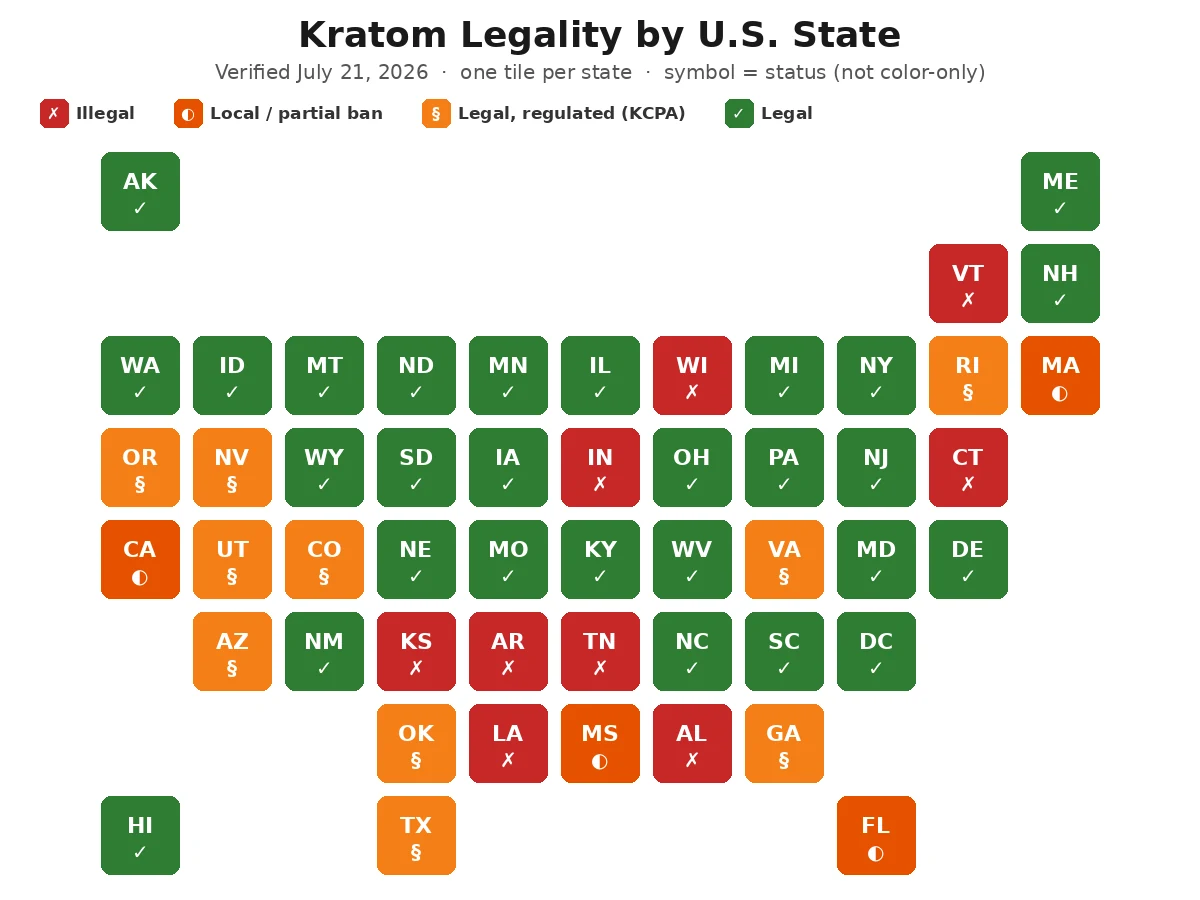
One tile per state, so small states stay readable. The full table below has the detail for each one.
Here's every state at a glance. I've color-coded them so you can quickly see where things stand. Scroll the table on mobile.
| State | Status | Notes |
|---|---|---|
| Alabama | Illegal | Banned since 2016. Mitragynine classified as Schedule I. |
| Alaska | Legal | No state-level restrictions. |
| Arizona | Legal (Regulated) | KCPA passed. Age restrictions, labeling requirements. |
| Arkansas | Illegal | Banned since 2015. Classified as controlled substance. |
| California | Partial Ban | Legal statewide, but banned in San Diego and Oceanside. |
| Colorado | Legal (Regulated) | KCPA passed. Legal statewide; banned in Parker (local ordinance). |
| Connecticut | Illegal | Schedule I controlled substance effective March 25, 2026. Possession, sale, and distribution prohibited. |
| Delaware | Legal | No state-level restrictions. |
| Florida | Partial Ban | Legal statewide (21+). Banned locally in Sarasota County. |
| Georgia | Legal (Regulated) | KCPA passed. Must be 18+ to purchase. Labeling rules. |
| Hawaii | Legal | No state-level restrictions. |
| Idaho | Legal | No state-level restrictions. |
| Illinois | Legal | Legal for 18+. Banned in Jerseyville, Alton and Edwardsville (local ordinances). |
| Indiana | Illegal | Banned since 2014. Synthetic mitragynine classified as controlled. |
| Iowa | Legal | No state-level restrictions. |
| Kansas | Illegal | Banned effective July 1, 2026. Kratom given the same controlled-substance status as heroin. |
| Kentucky | Legal | No state-level restrictions. Bills have been proposed but not passed. |
| Louisiana | Illegal | Schedule I controlled substance effective August 1, 2025 (SB 154 / Act 41). Possession, sale, and manufacture criminalized. |
| Maine | Legal | No state-level restrictions. |
| Maryland | Legal | No state-level restrictions. |
| Massachusetts | Partial Ban | Legal statewide, but local Boards of Health have banned sales on Martha's Vineyard: Edgartown (June 9, 2026) and Tisbury (July 2026). Both ban local sale/distribution "in any form"; neither addresses personal possession, and mail order to residents is not blocked. A statewide ban bill is pending. |
| Michigan | Legal | No state-level restrictions. |
| Minnesota | Legal | No state-level restrictions. |
| Mississippi | Partial Ban | Legal at state level. Banned in some counties. |
| Missouri | Legal | No state-level restrictions. |
| Montana | Legal | No state-level restrictions. |
| Nebraska | Legal | No state-level restrictions. |
| Nevada | Legal (Regulated) | KCPA passed. Labeling and age requirements. |
| New Hampshire | Legal | No state-level restrictions. |
| New Jersey | Legal | No state-level restrictions. |
| New Mexico | Legal | No state-level restrictions. |
| New York | Legal | No state-level restrictions. |
| North Carolina | Legal | No state-level restrictions. |
| North Dakota | Legal | No state-level restrictions. |
| Ohio | Legal | Board of Pharmacy considered ban; it did not move forward. |
| Oklahoma | Legal (Regulated) | KCPA passed. Age and labeling requirements. |
| Oregon | Legal (Regulated) | KCPA passed. Regulated for age, labeling, and testing. |
| Pennsylvania | Legal | No state-level restrictions. |
| Rhode Island | Legal (Regulated) | Reversed its 2017 ban on April 1, 2026 under a KCPA-model law. Legal for 21+ with lab-testing and labeling rules. |
| South Carolina | Legal | No state-level restrictions. |
| South Dakota | Legal | No state-level restrictions. |
| Tennessee | Illegal | Banned effective July 1, 2026 (HB1649 / SB1656, Public Chapter 950). Previously legal for 21+. |
| Texas | Legal (Regulated) | Legal with 2% 7-hydroxymitragynine cap. Labeling required. |
| Utah | Legal (Regulated) | KCPA passed (first state). Age, labeling, and testing rules. |
| Vermont | Illegal | Banned since 2016. Kratom alkaloids classified as regulated drugs. |
| Virginia | Legal (Regulated) | KCPA passed. Must be 21+ to purchase. |
| Washington | Legal | No state-level restrictions. |
| West Virginia | Legal | No state-level restrictions. |
| Wisconsin | Illegal | Banned since 2014. Mitragynine and 7-OH classified as Schedule I. |
| Wyoming | Legal | No state-level restrictions. |
Washington, D.C.: kratom is prohibited in the District of Columbia. D.C. is not a state, so it isn't in the 50-state table above, but if you live there, the answer is no.
States Where Kratom Is Illegal
Let me walk through each state that has fully or mostly banned kratom, because the specifics matter.
Alabama
Alabama added mitragynine and 7-hydroxymitragynine to its Schedule I controlled substances list in 2016. There have been efforts by advocates to reverse this, but as of 2026, kratom remains fully illegal in Alabama. Possession can result in criminal charges. If you live in Alabama, I genuinely feel for you, but please don't risk it.
Arkansas
Arkansas banned kratom in 2015 by classifying its active alkaloids as controlled substances. The ban has been challenged by the American Kratom Association and local advocates multiple times, but nothing has changed yet. Still fully illegal.
Connecticut
Connecticut designated mitragynine and 7-hydroxymitragynine as Schedule I controlled substances, with the ban taking effect March 25, 2026. It was the seventh state to schedule kratom this way. Possession, sale, and distribution are now all illegal, and retailers were ordered to pull product from shelves.
Indiana
Indiana was one of the first states to ban kratom back in 2014. They added synthetic mitragynine to their controlled substances list. It's been illegal ever since, and there hasn't been much legislative movement to reverse the ban.
Kansas
Kansas is one of the newest additions to the banned list, with its prohibition taking effect July 1, 2026. The law classifies kratom's alkaloids alongside Schedule I substances like heroin. If you're in Kansas, kratom is no longer legal to buy, possess, or sell.
Louisiana
Louisiana banned kratom through Senate Bill 154 (Act 41), which classified it as a Schedule I controlled substance effective August 1, 2025. Possession, sale, and manufacture are all criminalized, with escalating penalties based on quantity. This came after the state had considered the KCPA route but ultimately went with a full ban.
Tennessee
Tennessee flipped from a regulated, 21-and-over market to a full ban effective July 1, 2026 (HB1649/SB1656, Public Chapter 950). Possession is now a Class A misdemeanor, and manufacture or sale is a Class C felony. This was a significant reversal for a state that had previously allowed legal, age-restricted sales.
Vermont
Vermont banned kratom in 2016 by classifying its alkaloids as regulated drugs. It's one of the smaller states by population, but the ban is firm and enforced. No legal way to buy or possess kratom in Vermont.
Wisconsin
Wisconsin classified both mitragynine and 7-hydroxymitragynine as Schedule I controlled substances in 2014. This is a hard ban, possession, sale, and distribution are all illegal. There have been recent advocacy efforts, but nothing has moved the needle yet.
Good News: Rhode Island Re-Legalized Kratom in 2026
For the first time, a state that had banned kratom reversed course. Rhode Island, which had classified mitragynine as a controlled substance back in 2017, repealed its ban effective April 1, 2026. The new law follows the Kratom Consumer Protection Act model: kratom is legal for adults 21 and older, with requirements for lab testing, accurate labeling, limits on 7-OH concentration, and a ban on synthetic alkaloid additives. It's a hopeful sign that advocacy can work, and a template other banned states may eventually follow.
If you're in a legal state and ready to buy, my tested list of the best kratom vendors covers who ships where and who actually lab-tests their product. New to kratom? Start with the kratom dosage calculator to find a sensible starting dose for your body weight.
California: Legal Statewide, but Watch the Local Bans
California is a weird one. At the state level, kratom is completely legal. There's no state law banning it, and you can buy it in most cities without any issues. However, a couple of cities have enacted their own local bans, and that trips people up.
San Diego banned the sale of kratom within city limits. You can't walk into a shop in San Diego and buy kratom. Oceanside, a city in San Diego County, has a similar ban in place.
Now, here's the thing, if you live in San Diego, you can still order kratom online from vendors in other states and have it shipped to your home. The local bans target retail sales, not personal possession in most interpretations. Just remember I'm not a lawyer, and you should research your local ordinances before making assumptions.
The broader California situation is worth watching because there have been attempts to pass a statewide KCPA, which would override local bans and create consistent regulation. I'd love to see that happen.
Texas: The 2% 7-Hydroxymitragynine Limit
Texas took a different approach than most states. Instead of banning kratom or leaving it completely unregulated, Texas passed a law that sets a cap on 7-hydroxymitragynine (7-OH) content at 2% of the total alkaloid profile in any kratom product.
Why does this matter? 7-OH is the more potent alkaloid in kratom. It's the one that, in high concentrations (especially in some extracts), can carry more risk. By capping it at 2%, Texas is essentially ensuring that only natural, unadulterated kratom leaf products are sold, not super-concentrated extracts spiked with synthetic 7-OH.
For everyday kratom users like me, this law doesn't change much. Standard kratom powder naturally contains well under 2% 7-OH. Where it does matter is for extract products. Some vendors have had to reformulate their Texas-sold products to comply. If you're ordering extracts in Texas, make sure your vendor is aware of and compliant with this law.
Texas also requires labeling on kratom products, including ingredient lists and manufacturer information. Honestly, I think Texas struck a reasonable balance here.
The 2026 Federal 7-OH Scheduling Action: What It Actually Covers
Direct answer: kratom itself is not being banned. Concentrated 7-OH is. As of July 21, 2026, kratom leaf and plain kratom powder are not federally controlled substances, and nothing in this action changes that.
Here is the timeline, from the primary sources:
| Date | What happened |
|---|---|
| July 1, 2026 | DEA announced it sent two Notices of Intent to the Federal Register. |
| July 6, 2026 | Both notices published in the Federal Register. |
| August 5, 2026 (earliest) | A temporary scheduling order cannot issue before roughly 30 days after publication. |
The two notices cover different things:
- Notice 1, 7-OH above a threshold. This would place 7-hydroxymitragynine into Schedule I only above a specified concentration. For botanical material of Mitragyna speciosa, the threshold is more than 0.050% 7-OH on a dry weight basis.
- Notice 2, semi-synthetic analogues. This covers mitragynine pseudoindoxyl, MGM-15, and MGM-16. These are not naturally occurring in meaningful amounts; they are lab-made.
What's next: the END 7-OH Act (H.R. 8000)
Alongside the DEA's temporary action, Congress is weighing a permanent fix aimed at the same target. The END 7-OH Act ("End Needless Distribution of 7-OH Act," H.R. 8000), introduced March 19, 2026 by Reps. Gus Bilirakis, Vern Buchanan and Laurel Lee, would place synthetic, concentrated 7-OH into Schedule I by statute while explicitly exempting 7-OH that occurs naturally in the kratom plant. As of July 21, 2026 it is early in the legislative process (introduced and referred to committee), not law. The takeaway is the same as the DEA notices: the line is drawn at concentrated/synthetic 7-OH, not at natural kratom leaf.
Why plain kratom powder is not affected
This is the part people are getting wrong, and it matters. Natural kratom leaf contains 7-OH only in trace amounts, far below the 0.050% dry-weight threshold. The alkaloid that makes ordinary kratom work is mitragynine (MIT), not 7-OH. The threshold was written specifically so that the leaf falls outside it, which is why the DEA's own framing is about enhanced and concentrated products rather than the plant.
What is in the blast radius: products that have been deliberately concentrated or spiked to have high 7-OH content. In practice that has meant certain extract tablets, gummies, and liquid shots. The FDA sent warning letters over exactly these products in 2025.
What this means if you buy kratom
Plain leaf powder and capsules are not covered. Natural 7-OH sits far below the 0.050% dry-weight threshold.
Extracts, tablets, gummies and shots may be. The notice explicitly names “extracts, concentrates, processed edibles, or pressed pills”, and it catches them on 7-OH content, more than 0.050%, or more than 1.00 mg per article, regardless of what the mitragynine label says. If you buy those formats, ask the vendor for a batch COA giving 7-OH in milligrams per unit.
I keep the full timeline, all three prongs of the definition, the open HHS comment period, and a dated update log in my 7-OH scheduling tracker. That page is the canonical one; this page is about state law.
If kratom is legal where you live and you want to know where I actually buy it: the two vendors I keep coming back to are Kraken Kratom and Happy Hippo, both AKA-GMP qualified. My 2026 vendor ranking lays out the reasoning, including what each of them does badly. Those are affiliate links, and they don't change the order of the list. Neither vendor ships to states where kratom is banned, so check your row in the table above first.
Primary sources: DEA press release (July 1, 2026) · Federal Register: 7-OH above a specified threshold · Federal Register: mitragynine pseudoindoxyl, MGM-15, MGM-16 · FDA on 7-OH products
I keep a dedicated, dated 7-OH scheduling tracker with the full timeline, an update log, and links to every primary source. If you want the running status rather than the summary, start there.
I am not a lawyer, and this is a moving target. A Notice of Intent is not a final order. I will update this section as the DEA acts, and I will date the change when I do.
What Is the Kratom Consumer Protection Act?
The Kratom Consumer Protection Act (KCPA) is model legislation drafted by the American Kratom Association (AKA) that states can adopt. Instead of banning kratom, the KCPA creates a regulatory framework that protects consumers while keeping kratom legal.
Here's what the KCPA typically includes:
- Age restrictions: You must be 18 or 21 (varies by state) to purchase kratom.
- Labeling requirements: Products must clearly list ingredients, alkaloid content, and the manufacturer.
- Contamination standards: Products cannot contain dangerous adulterants or contaminants.
- 7-OH limits: Some versions cap the concentration of 7-hydroxymitragynine to prevent dangerously potent products.
- Penalties for violations: Vendors who sell adulterated or mislabeled products face fines and other consequences.
As of 2026, the following states have passed some version of the KCPA: Arizona, Colorado, Georgia, Nevada, Oklahoma, Oregon, Rhode Island, Utah, and Virginia. Several more states have active KCPA bills in their legislatures.
I'm a big supporter of the KCPA approach. Banning kratom pushes people toward unregulated (and potentially dangerous) sources. Smart regulation protects consumers without taking away access. If your state is considering a KCPA bill, I'd encourage you to contact your representatives and voice your support.
Frequently Asked Questions
Is kratom legal at the federal level?
Yes. As of July 21, 2026, kratom is not a federally controlled substance. The DEA considered scheduling it in 2016 but withdrew that proposal after massive public backlash. The FDA has not approved kratom for any medical use, but it has not been banned federally.
One important 2026 update: on July 1, 2026 the DEA moved to temporarily place concentrated 7-hydroxymitragynine (7-OH) into Schedule I, with the order taking effect no earlier than August 5, 2026. This does not ban kratom leaf or plain kratom powder, which contain only trace 7-OH, well below the 0.050% dry-weight threshold in the notice. It targets enhanced, high-7-OH products. See the full breakdown.
Is kratom legal in Massachusetts?
Kratom is legal at the Massachusetts state level as of July 21, 2026, but local Boards of Health on Martha's Vineyard have banned it. Edgartown banned kratom sales on June 9, 2026, and the Tisbury Board of Health unanimously banned the local manufacturing, sale, and distribution of kratom "in any form" in July 2026. These are local sale bans: neither addresses personal possession, and by their own terms they do not stop a resident from ordering kratom by mail. A Massachusetts statewide ban bill has been filed but is not law. Expect more Massachusetts towns to weigh similar Board of Health regulations.
What is the END 7-OH Act (H.R. 8000)?
The END 7-OH Act ("End Needless Distribution of 7-OH Act," H.R. 8000) is a federal bill introduced on March 19, 2026 by Reps. Gus Bilirakis, Vern Buchanan, and Laurel Lee. It would place synthetic, concentrated 7-hydroxymitragynine (7-OH) into Schedule I while exempting 7-OH that occurs naturally in the kratom leaf. As of July 21, 2026 it is early in the process (introduced and referred to committee), not law. Like the DEA's July 2026 temporary scheduling notices, it targets concentrated/synthetic 7-OH, not natural kratom powder. See the dated 7-OH tracker.
Can I fly with kratom?
If you're flying from and to states where kratom is legal, you should be fine. The TSA is not specifically looking for kratom, they're focused on security threats. However, if your destination state has banned kratom, you could face legal issues upon arrival. I keep my kratom in its original labeled packaging when I travel, just to avoid any confusion.
Can I order kratom online if my state has banned it?
Most reputable vendors will not ship to states where kratom is illegal. They check shipping addresses and block orders to banned states. If a vendor is willing to ship kratom to Alabama, Indiana, or other banned states, that's actually a red flag, it means they're not following the law, and they're probably not following other quality standards either.
Could kratom become federally banned?
It's possible but increasingly unlikely. The trend has been toward regulation rather than prohibition. The AKA has been effective at advocating at both state and federal levels, and the KCPA model has gained significant traction. But I never take anything for granted, which is why I support advocacy efforts and encourage you to stay informed.
What happens if my state bans kratom after I've been using it?
This is a fear a lot of us share. If your state passes a ban, assume there is no grace period. Kansas and Tennessee both took effect on July 1, 2026 and neither provided an amnesty for kratom people already owned. Kansas told residents and retailers to dispose of product before the effective date; possession of a Schedule I substance there is a felony on a first offense. Stop buying and dispose of what you have before the law takes effect, and watch your state legislature rather than waiting to be told. I'd recommend joining the AKA's mailing list and following your state legislature so you're not caught off guard. Advocacy before a ban passes is way more effective than trying to reverse one after the fact.
Is kratom legal in the military?
This is a separate issue from state law. The Department of Defense has not banned kratom, but individual branches and commanders may have their own policies. Some military installations have banned the sale of kratom on base. If you're active duty, check with your command before using kratom, the rules can vary and consequences for violations can be serious.
Note: I do my best to keep this page accurate, but I'm not a lawyer and laws change. Always verify your local and state laws before purchasing kratom. Last updated July 21, 2026.