Is 7-OH Banned? The 2026 DEA Scheduling Tracker
By Ryan Carter. I check this page against the DEA, the Federal Register, and the FDA directly, and I date every change in the update log at the bottom. If something here is out of date, the primary sources linked throughout are the source of truth, not me.
Current status, as of July 21, 2026
- 7-OH is not yet federally scheduled. The DEA has stated its intent to schedule it. No order has issued.
- Kratom leaf and plain kratom powder are NOT covered. This is not a kratom ban.
- Earliest possible effective date: August 5, 2026.
- What is targeted: concentrated 7-OH above a threshold, plus three lab-made analogues.
The Short Answer
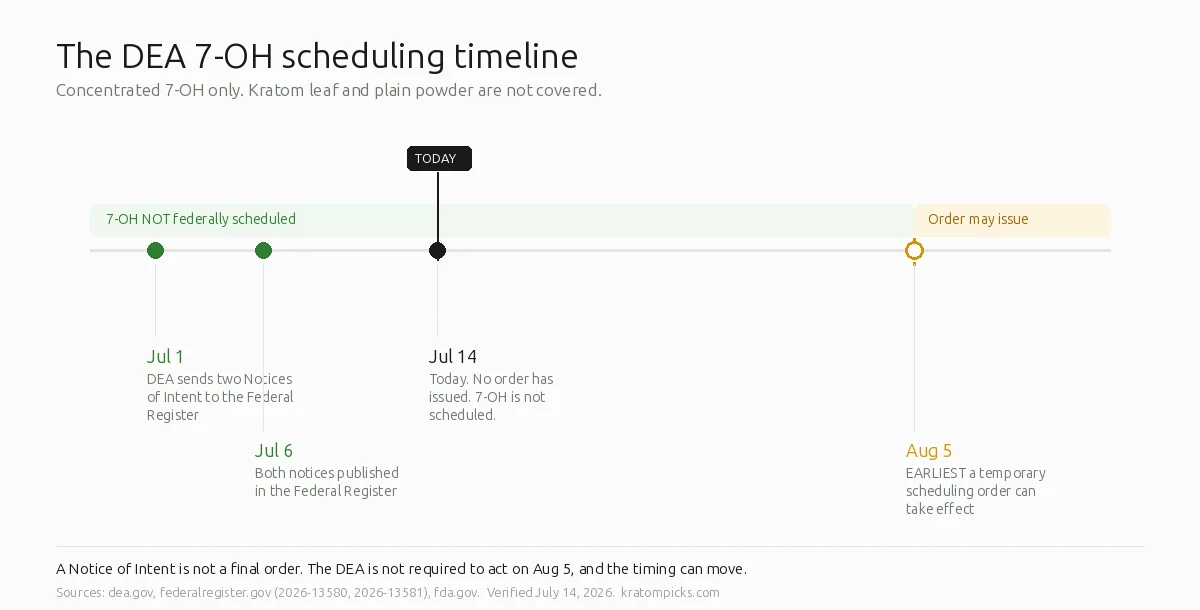
No, 7-OH is not banned yet, and kratom is not being banned at all. On July 1, 2026 the DEA sent two Notices of Intent to the Federal Register proposing to temporarily place concentrated 7-hydroxymitragynine into Schedule I. They were published on July 6. A temporary scheduling order cannot issue before roughly August 5, 2026. A Notice of Intent is a statement of what an agency plans to do, not the thing itself.
I want to be blunt about why this page exists. When the news broke, the headlines I saw were some version of "DEA moves to ban kratom." That is not what happened, and the difference is not academic if you are sitting on a kilo of powder wondering whether you just became a criminal. You did not. Here is the actual scope.
The Timeline
| Date | What happened | Status |
|---|---|---|
| July 1, 2026 | DEA announced it had sent two Notices of Intent to the Federal Register. | Confirmed |
| July 6, 2026 | Both notices published in the Federal Register. | Confirmed |
| August 5, 2026 | Earliest date a temporary scheduling order can issue (roughly 30 days after publication). | Not yet reached |
| If an order issues | Covered 7-OH substances become subject to the criminal, civil, and administrative provisions of the Controlled Substances Act. | Pending |
Note the DEA is not required to act on August 5. That is the earliest it can. Temporary scheduling can also be extended. I will date any change here as it happens.
There is an open public comment period, and it closes July 31, 2026. Alongside the two DEA notices, HHS opened a docket (HHS-OASH-2026-0232) asking for input on the proposed 7-OH threshold. If you have a view on where the line should sit, that is the place it counts.
Read the HHS request for informationWhat the Two Notices Actually Cover
Notice 1: 7-OH above a threshold
This is the one people are talking about, and the threshold is the whole story. It would place 7-hydroxymitragynine into Schedule I only above a specified concentration. For botanical material of Mitragyna speciosa, that threshold is more than 0.050% 7-OH on a dry weight basis.
Plain leaf sits far below that threshold. I should be careful here though: the notice says the threshold was “adapted from the definition used by the Department of Health and Human Services”, it does not say it was designed to exempt the plant. That the leaf falls outside it is a fact. Why it falls outside it is not something the DEA has told us, and I shouldn’t pretend otherwise.
Notice 2: the semi-synthetic analogues
The second notice covers mitragynine pseudoindoxyl, MGM-15, and MGM-16. These are not meaningfully present in the leaf. They are made in a lab. There is no "but my powder naturally contains some" argument to be had here, and honestly, there shouldn't be. These do not belong in a consumer product.
The Legislative Track: the END 7-OH Act (H.R. 8000)
The DEA notices are the fast track, but there is a parallel legislative one. On March 19, 2026, Reps. Gus Bilirakis, Vern Buchanan and Laurel Lee introduced the END 7-OH Act ("End Needless Distribution of 7-OH Act," H.R. 8000). It would place synthetic, concentrated 7-OH into Schedule I of the Controlled Substances Act by statute, while explicitly exempting 7-OH that occurs naturally in the kratom plant.
Two things worth keeping straight. First, as of July 21, 2026 this is a bill, early in the process (introduced and referred to committee), not a law and not a scheduling order. Second, it draws the same line the DEA drew: the target is concentrated/synthetic 7-OH, not natural kratom leaf. If it became law it would make the 7-OH schedule permanent rather than temporary, but it would not, on its face, ban plain kratom powder. I'll track its status in the update log below.
Is My Kratom Affected?
This is the only question most people came here for. I got it wrong when I first wrote this page, so let me be precise about what the notice actually says.
Correction, July 14, 2026. An earlier version of this page said that mitragynine extracts were not covered, on the theory that the action targets 7-OH rather than mitragynine. That was wrong. The notice covers processed dosage forms by their 7-OH content, not by which alkaloid the label advertises.
If you bought an extract, tablet, gummy or shot on the strength of what this page used to say, please read the corrected table below.
The scheduled category has three prongs, and the ones that matter for finished products are the second and third:
- (A) Botanical material of Mitragyna speciosa containing more than 0.050% 7-OH on a dry weight basis.
- (B)(i) Synthetic material containing 7-OH in amounts greater than 0.050% w/w, w/v or v/v, or greater than 1.00 mg of 7-OH in the article.
- (B)(ii) Material derived from Mitragyna speciosa and further processed to manufacture “alternative dosage forms such as extracts, concentrates, processed edibles, or pressed pills”, including material exposed to chemical or thermal methods causing chemical transformation, that results in 7-OH greater than 0.050% or greater than 1.00 mg in the article.
Two things follow from that, and both cut against what most coverage is telling you.
The rule names extracts, concentrates, edibles and pressed pills explicitly. A tablet is a pressed pill. A gummy is a processed edible. A shot is a concentrate. Being marketed as a mitragynine product does not put a product outside the rule, because the rule does not ask what the label says. It asks how much 7-OH is in the article.
There is an absolute milligram trigger, not just a percentage. More than 1.00 mg of 7-OH per article is enough on its own. A concentrated tablet can sit comfortably under 0.050% by weight and still cross the line on the milligram prong. And mitragynine oxidises into 7-OH under exactly the heat and chemical processing that prong (B)(ii) describes, which makes processed extracts the most likely category to be swept in, not the least.
| Product type | Covered? | Why |
|---|---|---|
| Plain leaf powder, any strain | No | Natural 7-OH is far below the 0.050% dry-weight threshold in prong (A) |
| Capsules of plain leaf | No | The same powder, encapsulated. Not a processed dosage form under (B)(ii) |
| Kilos and bulk powder | No | Still plain leaf. Prong (A) is a concentration test, not a quantity test |
| Extract tablets and pressed pills | Possibly, ask for a COA | Named in prong (B)(ii). Depends on 7-OH mg per tablet, not on the mitragynine figure |
| Gummies and processed edibles | Possibly, ask for a COA | Named in prong (B)(ii) |
| Liquid extract shots and concentrates | Possibly, ask for a COA | Named in prong (B)(ii) |
| Mitragynine pseudoindoxyl, MGM-15, MGM-16 | Yes | Covered outright by the second notice |
What to actually do about it
If you buy plain powder or capsules, which is what most long-term users do, and what I do, nothing in your cabinet is affected.
If you buy extracts, tablets, gummies or shots, ask the vendor one question: how many milligrams of 7-OH are in one unit of this product? Not the mitragynine content. The 7-OH content. A vendor who can answer that from a batch COA is a vendor who has done the work. A vendor who answers by pointing at the mitragynine number on the label has not answered the question.
I am not going to tell you a specific extract product is safe, because I have not seen a batch COA quantifying 7-OH in milligrams per unit for any of them, and neither, most likely, has the person who sold it to you. Anyone telling you their extract is definitely fine, without that number, is guessing. That includes the earlier version of this page.
My guide to reading a lab report covers what a real COA should show you.
7-OH vs Mitragynine: Why the Distinction Is the Whole Point
Kratom leaf contains dozens of alkaloids. Two of them matter for this conversation.
Mitragynine (MIT) is the main event. It is the most abundant alkaloid in the leaf by a wide margin, and it is what makes ordinary kratom powder do what it does.
7-hydroxymitragynine (7-OH) is present in the raw leaf only in trace amounts, but it is dramatically more potent at the opioid receptor than mitragynine is. In the plant, that does not matter much, because there is so little of it. The problem arises when someone isolates it, concentrates it, and puts a large dose of it into a gummy.
That is the product category the DEA is aiming at, and I will say plainly that I think they are aiming at the right thing. I have been using kratom for ten years and I have watched high-7-OH products flood into gas stations over the last couple of years, sold next to the leaf as if they were the same category of thing. They are not. A 7-OH tablet is to kratom powder roughly what a shot of grain alcohol is to a beer, and it has been marketed with none of that honesty. The FDA sent warning letters over exactly these products in 2025.
My concern with this action is not the target. It is that "kratom banned" headlines will push ordinary powder users toward panic, and that regulators historically have not been careful about the distinction. So far, on paper, this one is.
How to Check What You're Actually Buying
Whatever happens on August 5, this action has already done something useful: it has made vendor labeling a lot easier to judge. Here is what to look for.
The label should state the 7-OH content, in milligrams per unit. Not the mitragynine content, that is a different number and it does not answer the question the DEA notice asks. Some vendors do market extract products as containing no 7-OH; that is a claim, not a measurement, and I would want to see it backed by a batch certificate of analysis before I relied on it.
If a product will not tell you its 7-OH content, don't buy it. That is my position regardless of what the DEA does, and it was my position before any of this. A vendor who is vague about the most potent alkaloid in their product is a vendor who is vague about everything, including the things you can't see, like heavy metals. Read my guide to reading a kratom lab report if you want to know what a real certificate of analysis should show you.
What This Means If You Buy Kratom
If you use plain powder or capsules: nothing changes. Buy as you always have. If anything, this is a good moment to buy from a vendor who publishes batch-level lab results, because the market is about to sort itself into vendors who label honestly and vendors who don't.
The two I buy from most are Kraken Kratom and Happy Hippo, both AKA-GMP qualified, and my full vendor ranking explains how they compare and where each one loses points. Those are affiliate links; the ranking is the same one I'd give you if they weren't.
If you use extracts: check whether yours is mitragynine-based or 7-OH-based. Most reputable extract lines are MIT-based. The gas-station gummies and the "ultra potent" tablets are where the 7-OH lives.
If you use high-7-OH products: understand that these may become Schedule I substances in a matter of weeks, and that there is no announced grace period for existing stock. I'm not a lawyer and this isn't legal advice, but I'd want to know that rather than find out.
If you're in a banned state: none of this changes your situation, which is governed by state law. See my state-by-state legality guide, which I keep updated separately.
Frequently Asked Questions
Is 7-OH banned?
Not yet, as of July 21, 2026. The DEA published Notices of Intent on July 6, 2026 proposing to temporarily place 7-OH above a specified threshold into Schedule I. An order cannot issue before roughly August 5, 2026. Until it does, 7-OH is not federally scheduled.
Does this ban kratom?
No. Kratom leaf and plain kratom powder are not covered. The threshold for botanical material is more than 0.050% 7-OH by dry weight, and natural leaf contains only trace amounts, far below that. This action targets products deliberately concentrated to high 7-OH content.
What is the difference between 7-OH and mitragynine?
Mitragynine (MIT) is the primary alkaloid in kratom leaf and the one ordinary powder works through. 7-OH is a minor alkaloid present in trace amounts in the leaf, but far more potent at the opioid receptor. The DEA action targets 7-OH, not mitragynine.
When does it take effect?
No earlier than about August 5, 2026, roughly 30 days after Federal Register publication. The DEA is not required to act on that date, and the timing could move.
What happens to 7-OH products I already own?
If an order issues, the manufacture, distribution, sale, and possession of covered 7-OH substances become subject to the criminal, civil, and administrative provisions of the Controlled Substances Act. There is no announced amnesty or grace period for existing consumer stock. This is not legal advice, and if this affects you, talk to someone qualified.
How do I know if my extract contains 7-OH?
Check the label and the certificate of analysis. A reputable vendor states alkaloid content in milligrams of mitragynine per serving. If a product won't tell you its 7-OH content, that alone is reason enough to avoid it.
Will this lead to a full kratom ban?
Nothing in these notices does that, and the 0.050% threshold appears deliberately written to exclude the leaf. The DEA did attempt to schedule kratom itself in 2016 and withdrew after significant public backlash. I'm not going to pretend to predict what regulators do next, but the trend at the state level has been toward regulation rather than prohibition, and this federal action is aimed at concentrates rather than the plant.
Update Log
| Date checked | Change |
|---|---|
| July 21, 2026 | Re-verified; no scheduling order has issued (status unchanged). Added the federal END 7-OH Act (H.R. 8000, introduced March 19, 2026), which would schedule synthetic 7-OH by statute while exempting naturally occurring 7-OH in kratom. |
| July 17, 2026 | Re-verified against the DEA and both Federal Register notices. No scheduling order has issued; status unchanged. Added state-legislation references (NCSL, LAPPA state-law summary, DCCCA). |
| July 14, 2026 | Page published. Status verified against the DEA press release, both Federal Register notices, and the FDA's 7-OH page. No scheduling order has issued. |
I'll add a row here every time I re-check, including the times nothing has changed. A tracker that only updates when there's news is a tracker you can't trust the silence of.
Primary Sources
- DEA press release, July 1, 2026
- Federal Register: Temporary Placement of 7-Hydroxymitragynine Above a Specified Threshold in Schedule I
- Federal Register: Temporary Placement of Mitragynine Pseudoindoxyl, MGM-15, and MGM-16 in Schedule I
- FDA: Hiding in Plain Sight, 7-OH Products
- HHS: FDA supports DEA 7-OH scheduling
- Congress.gov: H.R. 8000, the END 7-OH Act (119th Congress)
State legislation and further reading
The federal 7-OH action is separate from state kratom law. For where the states stand on kratom and 7-OH, these are the references I check:
- National Conference of State Legislatures (NCSL): Lawmakers Weigh Guardrails, Bans on Kratom and 7-OH
- Legislative Analysis and Public Policy Association: Kratom, Summary of State Laws (PDF)
- DCCCA: Kratom overview and resources
For the full state-by-state breakdown on this site, see my kratom legality guide.
Note: I am not a lawyer and this is not legal advice. This is a fast-moving regulatory situation and a Notice of Intent is not a final order. Verify current status against the primary sources above before making any decision. Last updated July 21, 2026.